
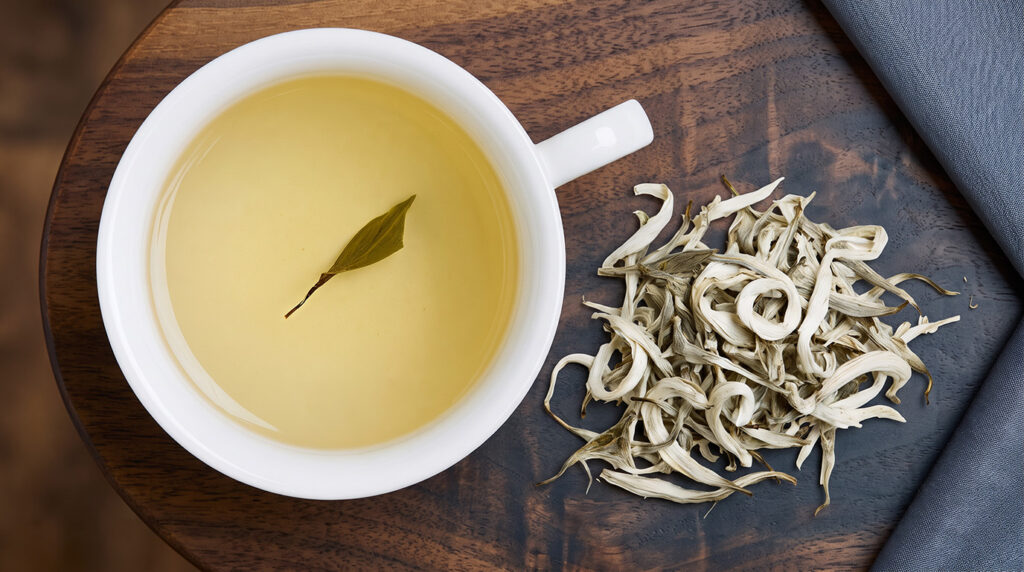
White tea is made from the young buds and leaves of the tea plant, Camellia sinensis. It comes from the same plant as green, oolong and black tea but undergoes relatively little processing—usually withering followed by drying.
Its name refers to the fine, silvery-white hairs found on young tea buds, not the color of the finished drink. Once brewed, white tea is generally pale straw, champagne or light gold.
How White Tea Is Made
After harvesting, the buds and leaves are spread out and allowed to wither, gradually losing moisture. They are then carefully dried.
Unlike green tea, white tea is not typically heated immediately after picking to halt oxidation. Gentle natural oxidation may occur during withering and drying, although considerably less than in oolong or black tea.
White teas vary according to the plant material used. Silver Needle is traditionally made primarily from unopened buds, while White Peony—also called Bai Mudan—includes buds and young leaves.
The flavor is usually delicate and lightly sweet, with notes that may be described as floral, honeyed, grassy, melon-like or reminiscent of dried hay. Flavor and color vary with the tea variety, growing region, harvest and preparation.arily appear bright green in the cup.
Bioactive Compounds & Research
White tea naturally contains polyphenols, including catechins and other flavonoids. It also contains caffeine and the amino acid L-theanine.
Because white tea is minimally processed, it is sometimes promoted as having more antioxidants than every other type of tea. The evidence is not that simple. Research comparing commercial white and green teas has found considerable variation in their polyphenol and caffeine content. The particular leaves, growing conditions, processing and brewing method can matter as much as the tea category itself.
White tea can contribute plant compounds to the diet, but claims that it detoxifies the body, prevents disease or produces dramatic health effects go beyond the available evidence. You can read more in this research comparing white and green teas.
Brewing & Considerations
White tea is commonly brewed with water below a full boil to preserve its delicate character. Exact temperatures and steeping times vary, so the instructions provided with the tea are a useful starting point. Hotter water or a longer steep generally produces a stronger, sometimes more bitter cup.
White tea contains caffeine. It is not automatically lower in caffeine than green, oolong or black tea—especially when the tea contains a high proportion of young buds. The amount in the cup depends on the tea, serving size, water temperature and steeping time.
People who are sensitive to caffeine may prefer a smaller serving, a shorter steep or a naturally caffeine-free herbal infusion instead.
Related Terms
Related glossary entries include Green Tea, Jasmine Tea, Oolong Tea, Black Tea, Matcha, Polyphenol, Flavonoid and Antioxidant.
A Note on Wellness Language
Wellness terms can change over time and may be used differently across scientific, traditional and commercial settings. Our goal is to explain them clearly, distinguish historical meaning from modern marketing, and give enough context for you to make sense of the language you encounter.
A Note on Educational Information
The information in this glossary is provided for educational purposes only. It is intended to explain terminology and provide context, not to diagnose, treat, cure or prevent disease, or replace advice from a qualified healthcare professional.
Return to the Herbal & Wellness Glossary
Return to the Herbal & Wellness Glossary to explore more terms, preparation methods and wellness concepts used throughout the site.
Silvery leaf. Gentle handling. A delicate cup. 🍵