
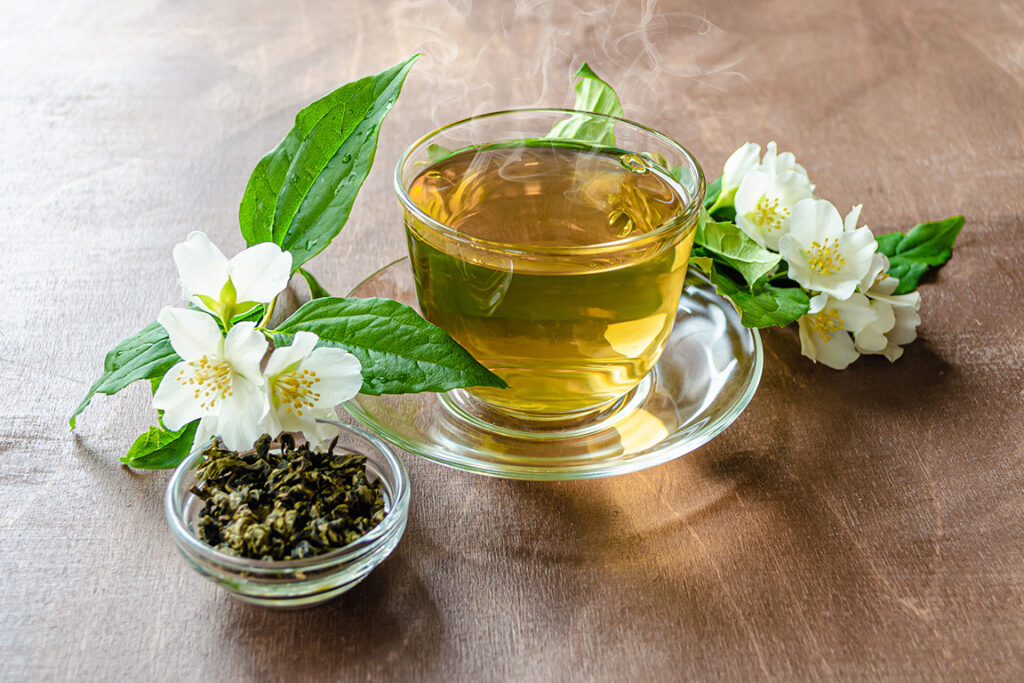
Jasmine tea is tea made by scenting finished leaves from the tea plant, Camellia sinensis, with fragrant jasmine blossoms—most commonly Jasminum sambac.
Green tea is the most familiar base, although white, oolong and black teas may also be scented with jasmine. The tea leaves provide the body, flavor and caffeine, while the blossoms contribute their distinctive floral aroma.
Jasmine tea is tea made by scenting finished leaves from the tea plant, Camellia sinensis, with fragrant jasmine blossoms—most commonly Jasminum sambac.
Green tea is the most familiar base, although white, oolong and black teas may also be scented with jasmine. The tea leaves provide the body, flavor and caffeine, while the blossoms contribute their distinctive floral aroma.
How Jasmine Tea Is Made
Jasmine-scented tea has a long history within Chinese tea culture.
During traditional production, finished tea leaves are mixed or layered with fresh jasmine blossoms as the flowers open and release their fragrance. The tea absorbs the aromatic compounds, after which the blossoms are separated and the tea is dried again.
Higher-quality teas may undergo several rounds of scenting to build a fuller, more lasting fragrance. Research into the jasmine tea scenting process confirms that the aroma profile changes as volatile compounds from the blossoms are transferred to the tea.
Not every jasmine tea is produced through repeated traditional scenting. Some products use jasmine extracts or added flavoring instead. An ingredient list may help identify whether a tea contains traditionally scented leaves, jasmine flowers, natural flavoring or a combination.
Visible petals do not necessarily indicate quality, and traditionally scented tea may contain few—or no—blossoms in the finished product.
Jasmine Tea vs. Jasmine-Flower Infusion
Jasmine tea and a jasmine-flower infusion are not the same beverage.
Jasmine tea contains leaves from Camellia sinensis that have been scented with jasmine blossoms.
A jasmine-flower infusion is made by steeping food-grade jasmine flowers without a true tea base. It is more accurately described as an herbal infusion or tisane.
This distinction matters because true jasmine tea naturally contains caffeine, while an infusion made only from jasmine flowers does not.
Tea Base, Caffeine & Brewing
The base tea determines much of jasmine tea’s flavor, color, caffeine content and ideal brewing method.
A green-tea base generally produces a lighter, fresher cup. White tea may be more delicate, oolong may add body or complexity, and black tea creates a darker, stronger brew beneath the floral aroma.
Because these bases all come from Camellia sinensis, they naturally contain caffeine. The amount varies with the tea, leaf quantity, water temperature and steeping time. Decaffeinated tea may still contain a small amount of caffeine.
Brewing directions should follow the needs of the base tea. Jasmine green tea usually benefits from cooler water and a shorter steep than jasmine black tea. Water that is too hot or steeping that continues too long may overpower the floral character with bitterness.
Related Terms
Related teas and concepts include Jasmine, Green Tea, White Tea, Oolong Tea, Black Tea, Matcha, Herbal Infusion and Tisane. These terms overlap in tea and herbal discussions, but they are not interchangeable and each has its own meaning and preparation.
A Note on Wellness Language
Wellness terms can change over time and may be used differently across scientific, traditional and commercial settings. Our goal is to explain them clearly, distinguish historical meaning from modern marketing, and give enough context for you to make sense of the language you encounter.
A Note on Educational Information
The information in this glossary is provided for educational purposes only. It is intended to explain terminology and provide context, not to diagnose, treat, cure or prevent disease, or replace advice from a qualified healthcare professional.
Return to the Herbal & Wellness Glossary
Return to the Herbal & Wellness Glossary to explore more terms, preparation methods and wellness concepts used throughout the site.
Tea carries the leaf. Jasmine lends the fragrance. 🌿