
Turkey Tail / Trametes versicolor
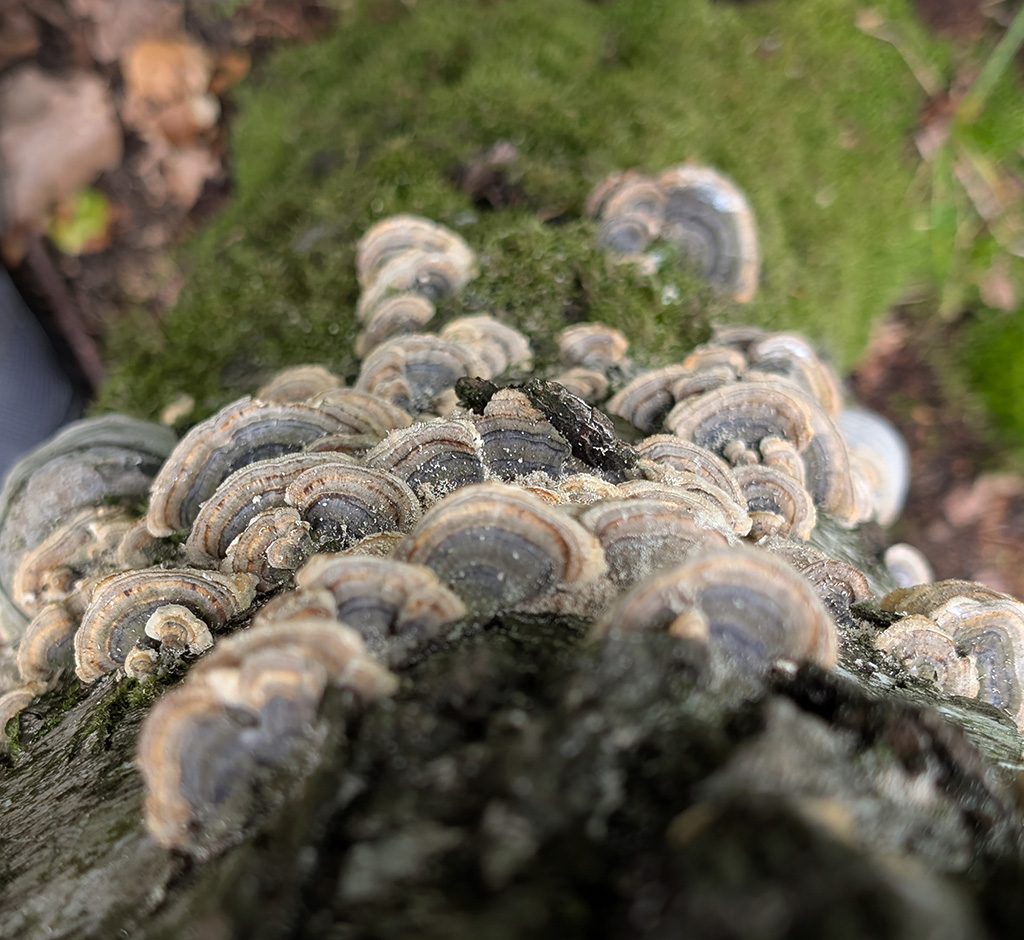
Turkey tail is a thin, fan-shaped mushroom named for the colorful concentric bands on its fruiting body, which resemble a turkey’s tail feathers. Trametes versicolor grows on dead and decaying wood in forests throughout much of the world and has a long history of traditional use in East Asia.
Botanical Snapshot
Common Name: Turkey Tail
Scientific Name: Trametes versicolor (L.) Lloyd
Former Name: Coriolus versicolor
Fungal Family: Polyporaceae
Organism Type: Wood-decaying bracket fungus
Distribution: Widely distributed in temperate forests worldwide
Part Commonly Used: Fruiting body and cultivated mycelium
Traditional Use & Bioactive Compounds
Turkey tail has a long history in Traditional Chinese Medicine, where it is known as Yun Zhi, and in Japanese traditional practice, where it is known as Kawaratake.
Its notable constituents include polysaccharides, beta-glucans and other bioactive compounds. Two extensively studied preparations are polysaccharide-K (PSK) and polysaccharopeptide (PSP).
PSK and PSP are specific extracts and should not be considered interchangeable with ordinary turkey tail mushroom powders or teas. Research has explored their effects on immune function and their use alongside conventional cancer treatment in parts of Asia, but turkey tail is not approved as a cancer treatment in the United States.
Common Forms & Preparations
Turkey tail is most commonly found as dried mushroom, powder, capsules, hot-water extracts and liquid extracts. Because the fruiting body is tough and leathery, it is generally prepared as a tea, decoction or extract rather than eaten like a culinary mushroom.
Safety & Considerations
Turkey tail and standardized extracts have generally been well tolerated in studies, although digestive discomfort and other mild effects can occur.
Mushroom supplements vary considerably in species, preparation and concentration. People undergoing cancer treatment, taking medications, pregnant or breastfeeding, or managing medical conditions should discuss concentrated mushroom products with a qualified healthcare professional.
Sourcing & Sustainability
Accurate identification matters because several Trametes species can closely resemble turkey tail. Look for products clearly labeled Trametes versicolor and, when possible, information about whether the product contains fruiting body, mycelium or a standardized extract.
Because turkey tail is widespread and can be cultivated, responsible commercial products do not generally require harvesting pressure on limited wild populations.
Cultural & Traditional Uses
Turkey tail has been used for centuries in East Asian traditional practices. In China it is known as Yun Zhi, while in Japan the name Kawaratake means “roof-tile mushroom,” referring to the overlapping appearance of its fruiting bodies. Extracts derived from the mushroom have also played a role in modern complementary medical practice in Japan and China.
Related Articles & Resources
Related terms include Beta-Glucan, Polysaccharide, Bioactive Compound and Antioxidant.
For additional research, see the National Cancer Institute article, Medicinal Mushrooms (PDQ®) — Turkey Tail and Polysaccharide-K (PSK).
A Note on Herbal Information
The information in this profile is provided for educational purposes and reflects a mix of botanical reference material, historical use, traditional practices and contemporary perspectives. It is not intended to diagnose, treat, cure or prevent disease, and it should not replace advice from a qualified healthcare professional.
Explore More Botanicals
Return to the Botanical Glossary to explore herbs, roots, flowers, spices and other botanicals along with their traditional uses, history, folklore and modern context.
Layers of color. Centuries of tradition. 🍄