Microgreens: Tiny Plants with a Powerful Nutritional Punch
By Catherine Costello
They may be tiny enough to fit in the palm of your hand, but microgreens have earned a surprisingly large place in the worlds of nutrition, agriculture and culinary arts.
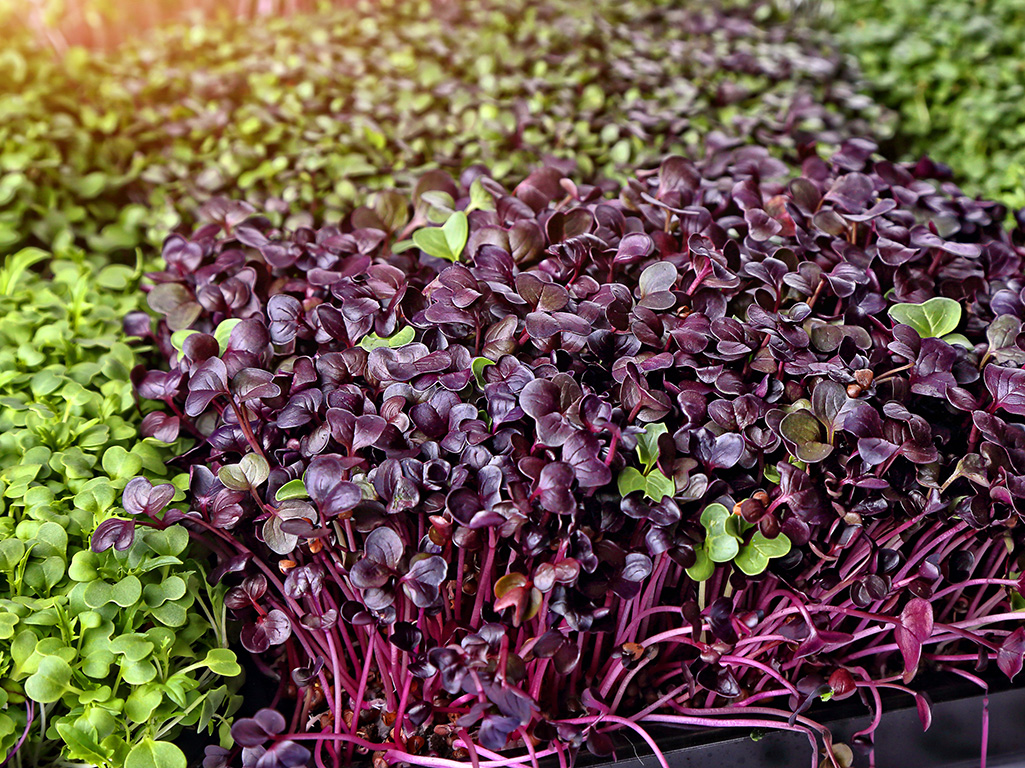
Once found mostly decorating plates in upscale restaurants, these colorful young greens have moved into farmers markets, grocery stores, home kitchens and even indoor gardens. Broccoli, radish, pea, sunflower, kale, basil and dozens of other familiar plants can all be harvested as microgreens.
Their growing popularity is not simply another food trend. Researchers have discovered that many microgreens contain impressive concentrations of vitamins, minerals and naturally occurring plant compounds. They are quick to grow, require relatively little space and offer an easy way to add fresh vegetables, flavor and variety to the diet.
But what exactly makes a plant a microgreen?
What Are Microgreens?
Microgreens are the young, edible seedlings of vegetables, herbs and some grains. They are generally harvested about 7 to 21 days after germination, depending on the plant variety and growing conditions.
At this stage, the plant has developed its first pair of seed leaves, called cotyledons, and often the beginnings of its first “true” leaves. Instead of allowing the plant to continue growing into a full-sized vegetable or herb, the young stem and leaves are cut just above the growing medium and eaten.
Microgreens occupy an interesting middle ground between sprouts and mature greens.
Sprouts are germinated seeds typically eaten after only a few days. The seed, root and developing shoot are usually consumed together. Microgreens grow longer, require light and are harvested above the soil or growing medium. Baby greens, such as baby spinach or lettuce, are allowed to mature longer and develop several true leaves before harvesting.
So while a broccoli sprout, broccoli microgreen and mature head of broccoli all begin with essentially the same seed, they are eaten at very different stages of the plant’s life.
Where Do Microgreens Come From?
Microgreens can be grown from many of the seeds already familiar to gardeners.
Popular varieties include:
- Broccoli
- Kale
- Cabbage
- Arugula
- Radish
- Mustard
- Beet
- Chard
- Pea
- Sunflower
- Cilantro
- Basil
- Dill
- Amaranth
The seeds are planted closely together in shallow trays containing soil, compost or another growing medium. Some commercial growers use hydroponic or soilless growing systems.
Once germination begins, the young plants are provided with water and light. Because they are harvested so early in their development, many varieties are ready within only two or three weeks.
Their small size and short growing cycle mean they can be produced on farms, in greenhouses, in sophisticated vertical-farming systems or on a sunny shelf at home. Modern controlled-environment farms can regulate lighting, irrigation, temperature and nutrients with remarkable precision.
This makes microgreens especially interesting to researchers studying urban agriculture and ways of producing fresh food where land or growing seasons are limited.
A Surprisingly Modern History
Humans have eaten tender young shoots and seedlings for a very long time, but microgreens as a distinct culinary category are relatively modern.
Accounts of the modern microgreen industry generally trace their rise to chefs in San Francisco during the 1980s. Early offerings were limited primarily to varieties such as arugula, basil, beets, cilantro and kale. Chefs valued them for their delicate textures, intense flavors and brilliant colors.
The word microgreens itself appears to have entered common American usage much later, around 1998. During the early 2000s, specialty growers began supplying them to local retailers, and by roughly 2010 they had become considerably more common in grocery stores and farmers markets.
Scientific interest followed. Researchers began investigating not only how to grow microgreens efficiently, but what happened nutritionally when vegetables were harvested during this very young stage of growth.
What they found helped transform microgreens from a pretty garnish into a subject of serious nutritional research.
Why Are Microgreens So Nutritious?
A seed contains stored nutrients designed to help a young plant survive until its roots and leaves are sufficiently developed to support continued growth.
During germination, the seedling undergoes rapid biochemical changes. Enzymes become active, stored compounds are mobilized and the growing plant begins producing pigments and phytochemicals needed for photosynthesis, growth and protection.
That brief period of intense plant development helps explain why microgreens can contain significant amounts of nutrients in a very small package.
One of the landmark studies was published in the Journal of Agricultural and Food Chemistry in 2012. Researchers analyzed 25 commercially available varieties of microgreens for vitamin C, carotenoids, vitamin K and vitamin E compounds.
The nutrient content varied dramatically by plant species — an important point that is sometimes lost in claims that all microgreens are nutritionally identical.
Among the varieties tested, red cabbage, cilantro, garnet amaranth and green daikon radish stood out for particularly high concentrations of different nutrients. Overall, the researchers found that the young cotyledon leaves often contained higher concentrations of the nutrients studied than mature leaves of the same plants.
Microgreens may provide varying amounts of:
Vitamin C, important for immune function, collagen formation and antioxidant protection.
Vitamin K, which plays an essential role in normal blood clotting and bone metabolism.
Vitamin E, a group of antioxidant compounds that help protect cells from oxidative damage.
Carotenoids, including beta-carotene and lutein, plant pigments involved in functions such as vision and cellular protection.
Minerals, which may include potassium, calcium, magnesium, iron, zinc and others depending on the plant and growing conditions.
Microgreens also contain numerous phytochemicals — naturally occurring plant compounds including phenolics, flavonoids, anthocyanins and glucosinolates. Different plant families produce different combinations of these compounds.
That means variety matters. Eating several kinds of microgreens can provide a broader range of plant compounds than relying on one variety alone.
So, Should We Be Eating Them?
For most people, microgreens can be an excellent addition to an already varied diet.
One of their biggest advantages is nutrient density. Because certain vitamins and phytochemicals may be concentrated in these young plants, even a small handful can add nutritional value to a meal.
They also make vegetables remarkably easy to incorporate into everyday foods.
A handful of radish microgreens can add peppery crunch to a sandwich. Pea shoots provide a mild sweetness to salads. Basil microgreens can finish a pasta dish. Broccoli or kale microgreens can disappear easily into wraps, bowls and omelets.
For someone who finds eating large servings of vegetables difficult, microgreens offer another way to introduce plant foods into meals.
They also provide something nutrition experts increasingly emphasize: diversity.
Different vegetables contain different combinations of vitamins, minerals, fiber and phytochemicals. Adding microgreens does not mean abandoning mature vegetables. Instead, they expand the variety of plants we can eat.
And that distinction is important.
Tiny, Yes. Miracle Food? No.
The term “superfood” is frequently attached to microgreens, but it is a marketing term rather than a scientific category.
Research clearly demonstrates that many microgreens are nutrient-rich. Laboratory and animal studies have also produced intriguing findings involving antioxidant activity, inflammation, blood sugar regulation and cardiovascular health.
However, evidence demonstrating specific disease-prevention effects in humans remains much more limited.
A 2025 randomized crossover study, for example, had healthy middle-aged and older adults consume two cups of red cabbage or beet microgreens daily for two weeks. Researchers found that the amount was generally well tolerated and participants were highly compliant, but the short study did not show changes in several cardiovascular or gut-microbiome measurements. The researchers concluded that longer and larger human studies are needed to determine specific health effects.
That is a useful reminder of how nutrition science works.
Finding antioxidants or other beneficial compounds in a food does not automatically prove that eating that food prevents or treats a particular disease.
Microgreens are best viewed as another nutrient-rich whole food, not medicine in miniature.
The Microgreen Advantage: Fresh Food in Small Spaces
Microgreens have another fascinating benefit that has little to do with vitamins.
They are remarkably efficient crops.
Their short growing period means multiple harvests can be produced in the time required to grow one mature vegetable crop. Their small size makes them compatible with indoor growing systems and vertical farms where trays are stacked under controlled lighting.
Researchers from institutions including the USDA, University of Maryland and NASA have studied microgreens as crops suitable for environments ranging from ordinary home gardens to advanced controlled agricultural systems.
For people interested in growing some of their own food but lacking a traditional garden, microgreens can be an approachable starting point.
A tray, appropriate seed, a clean growing medium, water and adequate light can produce fresh edible greens within weeks.
There is something rather wonderful about that.
What About Food Safety?
Because microgreens are frequently eaten raw, good food-handling practices matter.
They should not be confused with sprouts when discussing food-safety risks. Sprouts are generally grown in warm, extremely moist environments that can also encourage the growth of bacteria if contamination is present. The FDA therefore has specific food-safety requirements for commercial sprout production.
Microgreens are harvested above the growing medium and are classified differently, but, like other fresh produce eaten raw, they can still become contaminated during growing, harvesting, storage or preparation.
Purchase microgreens from reputable growers, keep commercially packaged greens refrigerated and follow safe produce-handling practices. Home growers should begin with clean equipment and seeds appropriate for food production rather than assuming every packet of garden seed is intended for microgreen use.
Small Greens, Big Possibilities
Microgreens are a fascinating reminder that food does not have to be exotic to be interesting.
A cabbage microgreen is still cabbage. A broccoli microgreen is still broccoli. We are simply eating the plant during an unusually active and nutrient-rich period in its development.
Their concentrated flavors, brilliant colors and impressive nutritional profiles have carried microgreens from restaurant garnishes to farms, laboratories, kitchens and windowsills around the world.
Should microgreens replace the vegetables already on our plates?
No.
But should they join them?
There is certainly a good case for it.
Adding a handful to a salad, sandwich, soup, wrap, grain bowl or breakfast may be one of the easiest ways to bring a little more plant diversity onto the plate.
Sometimes good things really do come in small packages. 🌱
Sources & Further Reading
- Xiao, Z., Lester, G. E., Luo, Y., & Wang, Q. (2012). Assessment of vitamin and carotenoid concentrations of emerging food products: Edible microgreens. Journal of Agricultural and Food Chemistry, 60(31), 7644–7651. DOI: 10.1021/jf300459b.
- Turner, E. R., Luo, Y., & Buchanan, R. L. (2020). Microgreen nutrition, food safety, and shelf life: A review. Journal of Food Science, 85. DOI: 10.1111/1750-3841.15049. Authors affiliated with the USDA Agricultural Research Service and University of Maryland.
- Teng, J., Liao, P., & Wang, M. (2021). The role of emerging micro-scale vegetables in human diet and health benefits—An updated review based on microgreens. Food & Function, 12(5), 1914–1932. DOI: 10.1039/D0FO03299A.
- Bhaswant, M., Shanmugam, D. K., Miyazawa, T., Abe, C., & Miyazawa, T. (2023). Microgreens—A comprehensive review of bioactive molecules and health benefits. Molecules, 28(2), 867. DOI: 10.3390/molecules28020867.
- Microgreens on the rise: Expanding our horizons from farm to fork. (2024). Heliyon. DOI: 10.1016/j.heliyon.2024.e25870.
- Lee, S. Y., Michell, K. A., Butler, M. M., et al. (2025). Feasibility and tolerability of daily microgreen consumption in healthy middle-aged/older adults: A randomized, open-label, controlled crossover trial. Nutrients, 17(3), 467. DOI: 10.3390/nu17030467.
- Penn State Extension. (2024). The ABCs of Microgreens. Pennsylvania State University.
- U.S. Food and Drug Administration. (2023). Guidance for Industry: Standards for the Growing, Harvesting, Packing, and Holding of Sprouts for Human Consumption. Includes the FDA distinction between sprouts and microgreens under the Produce Safety Rule.
A Note on Educational Information
The information shared in Tools to Heal Your World is intended for educational and informational purposes only. Contributors share their own research, knowledge, experience, and perspectives. Nothing presented here is intended to diagnose, treat, cure, or prevent any condition, or to replace guidance from a qualified professional.

Catherine Costello
Curious Generalist • Research-Driven Writer • Life Long Learner • Rock Hound
Small-business owner, creative, rock hound, and unapologetically curious generalist, Cat follows interesting questions wherever they lead. Her research-driven articles explore everything from herbs, geology, and science to history, folklore, spirituality, and the occasional irresistible rabbit hole.